Introduction: A Rare and Complex Cancer Diagnosis
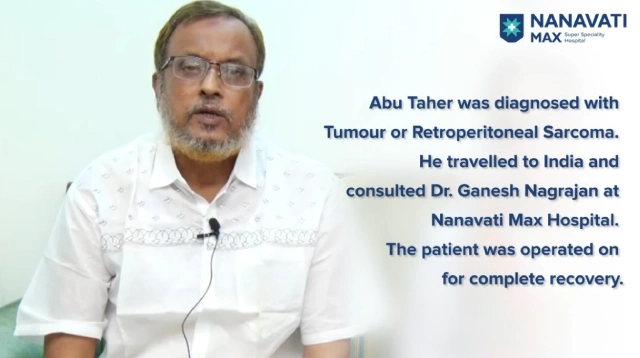
Cancer diagnosis can be overwhelming, especially when the tumor develops in deep areas of the abdomen that involve major blood vessels and organs. This case study highlights the journey of Professor Md. Abu Taher from Bangladesh, who was diagnosed with retroperitoneal sarcoma, a rare soft tissue cancer located deep inside the abdomen.
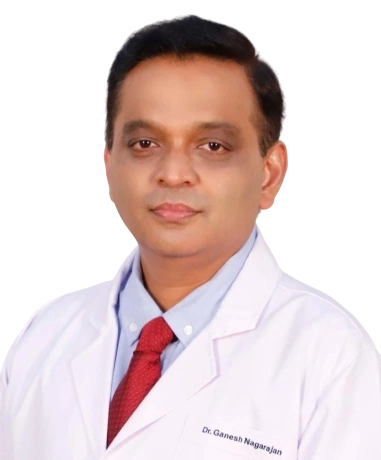
Seeking advanced treatment and surgical expertise, he travelled to India, where he consulted Dr. Ganesh Nagarajan, a specialist known for handling complex abdominal cancer surgeries.
This case demonstrates how careful surgical planning and expert oncology care can successfully treat even highly complicated tumors. This case comes under the Complex GI & Hepatopancreatobiliary (HPB) Surgery.
Understanding Retroperitoneal Sarcoma
Retroperitoneal Sarcoma is a rare type of cancer that develops in the retroperitoneum, the deep space in the abdomen located behind the stomach, intestines, and liver.
Why It Is Difficult to Treat
Retroperitoneal tumors are often challenging because they can:
- Grow silently without early symptoms
- Become very large before diagnosis
- Involve major organs and blood vessels
- Require highly specialized surgical expertise
In many cases, the tumor may surround structures such as the Inferior Vena Cava or the Kidney, making surgical removal extremely complex.
Patient Background: How the Tumor Was Discovered
Professor Md. Abu Taher, the Principal of Cumilla Government College in Bangladesh, discovered the tumor during a routine medical check-up.
Initial scans revealed a large abdominal mass, which was later diagnosed as retroperitoneal sarcoma. Due to the complexity of the condition, he decided to travel to India to seek advanced cancer treatment.
After further imaging and evaluation, doctors confirmed that surgical removal of the tumor was necessary.
Consulting a Specialist in Complex Cancer Surgery
Upon arriving in India, the patient consulted Dr. Ganesh Nagarajan, a leading expert in complex abdominal and hepatobiliary cancer surgeries.
Initial Assessment and Diagnostic Findings
The scans showed a large tumor located deep in the retroperitoneum with several complications:
- The tumor was located behind the liver
- It was closely attached to the inferior vena cava
- The blood vessels supplying the right kidney were wrapped around the tumor
- The vena cava was severely compressed
These findings made the surgery extremely delicate and high-risk.
The Surgical Challenge
The main challenge was to remove the tumor completely while preserving vital organs and blood vessels.
Key surgical concerns included:
- Protecting the right kidney
- Carefully separating the tumor from the inferior vena cava
- Detaching the tumor from the liver
- Preventing damage to the surrounding vascular structures
The patient was especially concerned about saving his kidney, which added another layer of complexity to the procedure.
Advanced Surgical Approach
During the surgery, the team led by Dr. Ganesh Nagarajan used a meticulous and step-by-step approach.
Key Surgical Steps
- Careful exposure of the retroperitoneal tumor
- Gradual separation of the tumor from the liver
- Delicate dissection around the inferior vena cava
- Identifying and preserving the renal vessels
- Complete removal of the tumor while protecting surrounding organs
Because the tumor was well-circumscribed, the surgeons were able to slowly separate it from critical structures.
This careful dissection allowed the team to preserve the right kidney and major blood vessels, which was one of the main goals of the surgery.
Successful Tumor Removal
After meticulous surgical work, the tumor was successfully removed completely.
The procedure achieved two major outcomes:
- Complete tumor excision
- Preservation of the patient’s right kidney
This outcome significantly improved the patient’s prognosis and recovery.
Recovery and Post-Surgery Outcome
Following the surgery, Professor Abu Taher recovered well and experienced significant improvement in his health.
He expressed appreciation for the hospital’s medical team, including:
- Doctors
- Nurses
- Support staff
- Hospital management
He described the care as patient-friendly, cooperative, and highly supportive, which helped him feel comfortable throughout his treatment journey.
Patient Testimonial
According to Professor Abu Taher:
“Today I feel much better. The doctors, nurses, and staff are very patient-friendly and sincere. I believe this is one of the best hospitals in India.”
His experience reflects the importance of expert surgical care and compassionate medical support in cancer treatment.
At Nanavati Max Super Speciality Hospital, advanced technology combined with the expertise of medical professionals allows a smooth recovery for patients. For more information, visit or call +91 77000 58024.
Watch the full video about Best Cancer Hospital in Mumbai, Nanavati Max Institute for Cancer Care.