Why Choosing the Right Pancreatic Cancer Surgeon Matters
Pancreatic cancer is one of the most challenging cancers to treat, and the surgeon’s experience directly impacts survival outcomes. Research consistently shows that patients who undergo pancreatic cancer surgery at high volume centres with experienced HPB surgeons have significantly better outcomes — lower complication rates, lower mortality, and longer survival — compared to patients treated at low-volume centres.
The Whipple procedure is one of the most complex operations in surgery, involving removal of multiple organs and a three-part reconstruction. The skill and experience of the surgeon performing this operation is the single most important factor in determining the outcome.
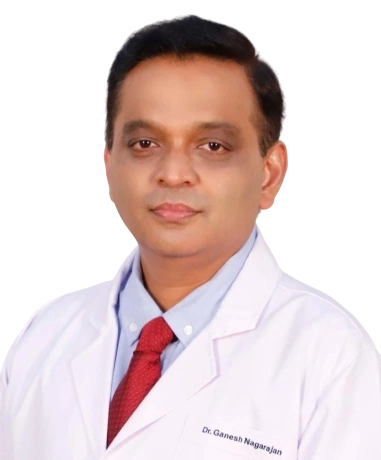
Dr. Ganesh Nagarajan — India’s Leading Pancreatic Cancer Surgeon
Dr. Ganesh Nagarajan brings an exceptional combination of training, experience, and surgical volume to pancreatic cancer care. He trained at two of the world’s premier institutions for HPB surgery: Tata Memorial Hospital, Mumbai (India’s foremost cancer centre) for surgical oncology, and Hospital Beaujon, Clichy, France under Prof. Jacques Belghiti — one of the world’s most celebrated hepatobiliary and liver transplant surgeons.
At Nanavati Max Institute of Cancer Care, Dr. Nagarajan and his team have performed close to 2,000 supra major surgeries over four years, with pancreatic cancer surgeries comprising a significant proportion. His expertise includes standard and complex Whipple procedures (including those with portal vein and superior mesenteric vein resection and reconstruction), distal and subtotal pancreatectomy (open, laparoscopic, and robotic), total pancreatectomy, and surgery for neuroendocrine tumours of the pancreas.
Comprehensive Pancreatic Cancer Treatment
Pancreatic cancer treatment at Nanavati Max follows a truly multidisciplinary approach. Every case is discussed at the tumour board comprising surgical oncologists, medical oncologists, radiation oncologists, radiologists, pathologists, and gastroenterologists. Treatment options may include upfront surgery for clearly resectable tumours, neoadjuvant chemotherapy to shrink borderline resectable tumours before surgery, adjuvant chemotherapy after surgery, and palliative care for advanced cases.
The hospital’s infrastructure supports the complete spectrum of pancreatic cancer care: state-of-the-art imaging (CT, MRI, PET-CT, endoscopic ultrasound), interventional radiology for stenting and drainage procedures, the latest in radiation therapy (Halcyon linear accelerators, SBRT), and the Da Vinci Xi robotic system for minimally invasive approaches.
When to Seek a Second Opinion for Pancreatic Cancer
If you or a loved one has been diagnosed with pancreatic cancer — particularly if you have been told the tumour is inoperable we strongly encourage seeking a second opinion from an experienced HPB surgeon. What may be considered inoperable at one centre may be resectable at a high-volume centre with expertise in vascular
reconstruction. Dr. Nagarajan offers virtual second opinions via WhatsApp video call and the hospital’s telemedicine platform.
Ready to discuss your treatment options? Dr. Ganesh Nagarajan is available for virtual consultations via WhatsApp video call or the hospital’s telemedicine platform.
Call +91 7304663828 | WhatsApp +91 7700058024 | Book Video Consultation
FAQ’S
What is the survival rate for pancreatic cancer surgery?
For patients who undergo a successful Whipple procedure followed by adjuvant chemotherapy, the 5-year survival rate ranges from 15-25%, significantly better than the 3-5% survival for patients who do not undergo surgery.
Is the Whipple procedure very risky?
At high-volume centres like Nanavati Max, the mortality rate for Whipple procedures is below 2%, and complication rates are comparable to international standards.
Can pancreatic cancer be treated without surgery?
Chemotherapy and radiation can control the disease temporarily, but surgery remains the only potentially curative treatment for pancreatic cancer.